NASA X-ray Spacecraft Discovers Supernova Wreckage at the Heart of the Milky Way
- Milky Way
- March 27, 2026
- 13
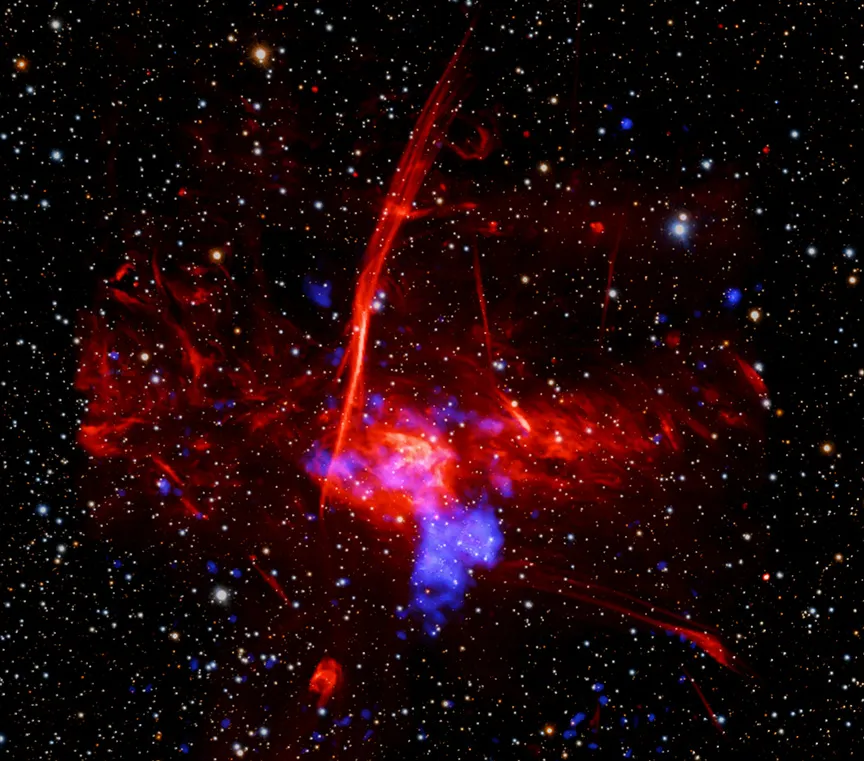
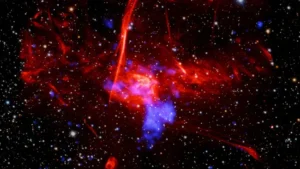
Data from NASA’s Chandra X-ray Observatory has revealed the remnants of a long-dead star near the center of the Milky Way, close to the supermassive black hole Sagittarius A*, located about 26,000 light-years from Earth.
The research team estimates that the star responsible for this debris exploded around 1,700 years ago, making it one of the most recent and nearest supernova remnants found in the galactic center region. The newly identified structure represents the closest known supernova debris to Sagittarius A*.
A high-speed stellar explosion remnant
The supernova debris lies within a region of ionized hydrogen gas that is a strong source of radio emission, known as Sagittarius C. X-ray observations from both the Chandra X-ray Observatory and the XMM-Newton X-ray Observatory revealed the structure as a distinct “blob” of high-energy emission.
Scientists estimate that the expanding shell of stellar material is moving at approximately 2 million miles per hour (3.2 million km/h), still racing outward from the original explosion.
Why supernova remnants matter
Supernova explosions play a critical role in shaping galaxies. When massive stars end their lives in these violent events, they release heavy elements such as carbon, oxygen, and iron — materials that were originally forged in the star’s core.
These elements are then dispersed into surrounding interstellar space, where they mix with gas and dust clouds. Over time:
- These enriched clouds collapse under gravity
- New stars begin to form
- Surrounding material forms disks and eventually planets
This process means that supernovae are essential to the chemical evolution of galaxies, including the formation of future star systems and potentially habitable worlds.
A key piece of the galactic center puzzle
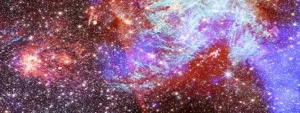
The discovery near Sagittarius A* provides rare insight into stellar evolution in one of the most extreme environments in the Milky Way. The galactic center is densely packed with stars, gas clouds, and strong gravitational forces, making it difficult to identify and study individual supernova remnants.
Finding such a young and relatively nearby explosion remnant in this region helps astronomers better understand:
- How often stars explode near the galactic center
- How energy and material are redistributed in this environment
- How stellar feedback influences future star formation