James Webb Space Telescope Detects ‘Galaxy-Killing’ Wind That May Explain Why Some Early Galaxies Died Young
- Research
- April 22, 2026
- 13
Using observations from the James Webb Space Telescope (JWST) and the Atacama Large Millimeter/submillimeter Array (ALMA), astronomers have uncovered new evidence that may help solve one of the biggest mysteries in galaxy evolution: why so many massive galaxies in the early universe stopped forming stars much sooner than expected.
Astronomers often describe galaxies as “alive” when they are actively creating new stars and “dead” when star formation has largely ceased. In the modern universe, dead galaxies are common. However, researchers have been surprised to discover large populations of massive dead galaxies during the universe’s earliest epochs, a time when galaxies were expected to be rapidly growing and producing stars at extraordinary rates.
By studying a distant galaxy with both JWST and ALMA, scientists detected what they describe as a “galaxy-killing” wind — a powerful, high-velocity outflow of gas capable of removing the raw material required for future star formation. The discovery could provide a natural explanation for the unexpectedly large number of massive dead galaxies observed throughout the young universe.
“Dense regions of the universe are like very active cities,” explained Rebecca Davies, lead author of the study from Swinburne University of Technology in Melbourne. “Galaxies collide and undergo intense bursts of star formation. But when the most massive stars reach the end of their lives, they explode as supernovas, generating powerful winds that expel the gas needed to sustain future star formation.”
Davies and her colleagues focused on a galaxy known as CRISTAL-02, observing it as it appeared approximately one billion years after the Big Bang. At the time, the galaxy was undergoing a period of rapid growth and intense stellar production.
The observations showed that CRISTAL-02 is forming stars at roughly twice the rate of other galaxies from the same era. At the same time, data from JWST and ALMA revealed a massive plume of cold gas extending far beyond the galaxy itself, indicating that enormous amounts of material are being expelled into intergalactic space.
“The galaxy has a powerful wind that is ejecting material at roughly twice the rate at which it is forming stars,” Davies said. “If this process continues, the galaxy could exhaust its star-forming fuel and effectively become dead in less than 50 million years, providing a possible explanation for the mysterious population of massive dead galaxies seen in the early universe.”
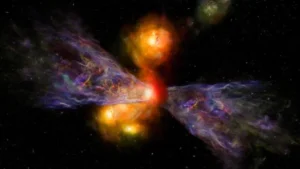
Researchers found another intriguing aspect of the system. CRISTAL-02 is not a single galaxy but rather a collection of galaxies in the final stages of merging together. During such mergers, large amounts of gas are driven toward the central regions of the galaxies, triggering intense bursts of star formation. These starburst events eventually lead to numerous supernova explosions, which generate the powerful winds capable of sweeping gas away and shutting down future star formation.
The findings suggest that galaxy mergers may play a much larger role in galactic evolution than previously thought. Observations indicate that nearly half of all massive galaxies in the early universe were interacting with neighboring galaxies. If mergers were indeed common, then the powerful outflows associated with these events may have been widespread as well.
As a result, many of the universe’s earliest giant galaxies may have effectively destroyed their own ability to create new stars. After a brief but extremely active period of growth, these galaxies would rapidly exhaust or expel their gas reservoirs, leaving them dormant and unable to sustain further stellar production.
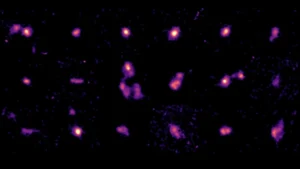
“If many early galaxies were colliding and experiencing these rapid growth phases, then it may not be surprising that we observe so many dead galaxies in the young universe,” Davies noted. “CRISTAL-02 provides a compelling and natural explanation for why these massive galaxies appear to live fast and die young.”
The discovery offers an important new perspective on how galaxies evolved during the universe’s first billion years and may help astronomers better understand the processes that shaped the large, mature galaxies observed today.