Scientists Solve 20-Year Mystery of Strange Radio Signals: A Vampire Star and Its Stellar Victim
- Exotic objects
- January 6, 2026
- 8
Astronomers have identified the source of a mysterious class of radio signals that has puzzled scientists for more than two decades. New research conducted by a team in Australia suggests that the signals originate from the interaction between a white dwarf star and a nearby red dwarf companion, forming what astronomers describe as a “vampire star” system.
The unusual signals, known as long-period radio transients, were first discovered in 2005. Unlike most cosmic radio emissions, which typically last only seconds or less, these signals can persist for several minutes or even more than an hour. To date, only about a dozen such objects have been identified, making them one of the more enigmatic phenomena in radio astronomy.

For years, scientists speculated that these bursts might originate from highly magnetized neutron stars known as magnetars. However, new observations led by Kovi Rose of the University of Sydney, using the Australian Square Kilometre Array Pathfinder (ASKAP) radio telescope, indicate that at least some of these signals are produced by symbiotic binary systems.
Symbiotic binaries consist of a compact stellar remnant, usually a white dwarf, that draws material from a nearby companion star. This process can eventually trigger explosive events known as novae when enough matter accumulates on the white dwarf’s surface.
“Long-period radio transients have puzzled astronomers for years,” Rose said in a statement. “Now we’ve been able to show that the source of one of these transients comes from a white dwarf actively pulling material from a companion star.”
The specific system studied by the team is designated ASKAP J1745-5051. It contains a white dwarf approximately the size of Earth but with a mass comparable to that of the Sun. Its companion is a red dwarf star with only about one-tenth of the Sun’s mass.
What makes ASKAP J1745-5051 particularly remarkable is that it emits not only long-duration radio bursts but also powerful X-ray flashes. These emissions are closely connected to the orbital motion of the two stars.
“These emissions are all tied to the orbital motion of the system,” Rose explained. “However, the radio and X-ray signals do not reach their maximum intensity at the same time, indicating that they are generated in different regions of the system.”
The X-ray radiation is produced as material from the red dwarf spirals toward the white dwarf. As the gas falls inward, gravity compresses and heats it to temperatures reaching hundreds of thousands or even millions of degrees. At such extreme temperatures, the material emits X-rays. The precise location where this process occurs depends on the changing positions of the two stars as they orbit one another.
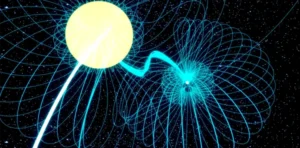
The origin of the radio signals is more complex. Both stars possess their own magnetic fields, and because their 1.4-hour orbit is highly elliptical rather than circular, the distance between them changes significantly over time. When the stars move closer together, their magnetic fields interact and collide.
This interaction strips charged particles from the surfaces of both stars. The particles then spiral along magnetic field lines, producing a type of radio emission known as synchrotron radiation. The radio bursts continue for as long as the magnetic fields remain in contact, recurring during each 1.4-hour orbit.
While the discovery provides a compelling explanation for ASKAP J1745-5051, researchers caution that it may not account for all long-period radio transients. Only one other known object in this category has been observed emitting X-rays, suggesting that multiple mechanisms could be responsible for these mysterious signals.
Nevertheless, the newly studied system may offer a valuable framework for understanding the broader population of long-period radio transients.
“This system gives us a way to decode these signals,” Rose said. “It could help us determine whether other long-period transients are more similar to pulsars or to white dwarf systems, effectively serving as a stellar Rosetta Stone.”
The findings represent an important step toward solving one of modern radio astronomy’s most persistent mysteries and may ultimately help researchers classify and understand a wide variety of unusual cosmic radio sources.