NASA Webb, Hubble Reveal History of Relic of Milky Way’s Formation
- Milky Way
- June 17, 2026
- 15
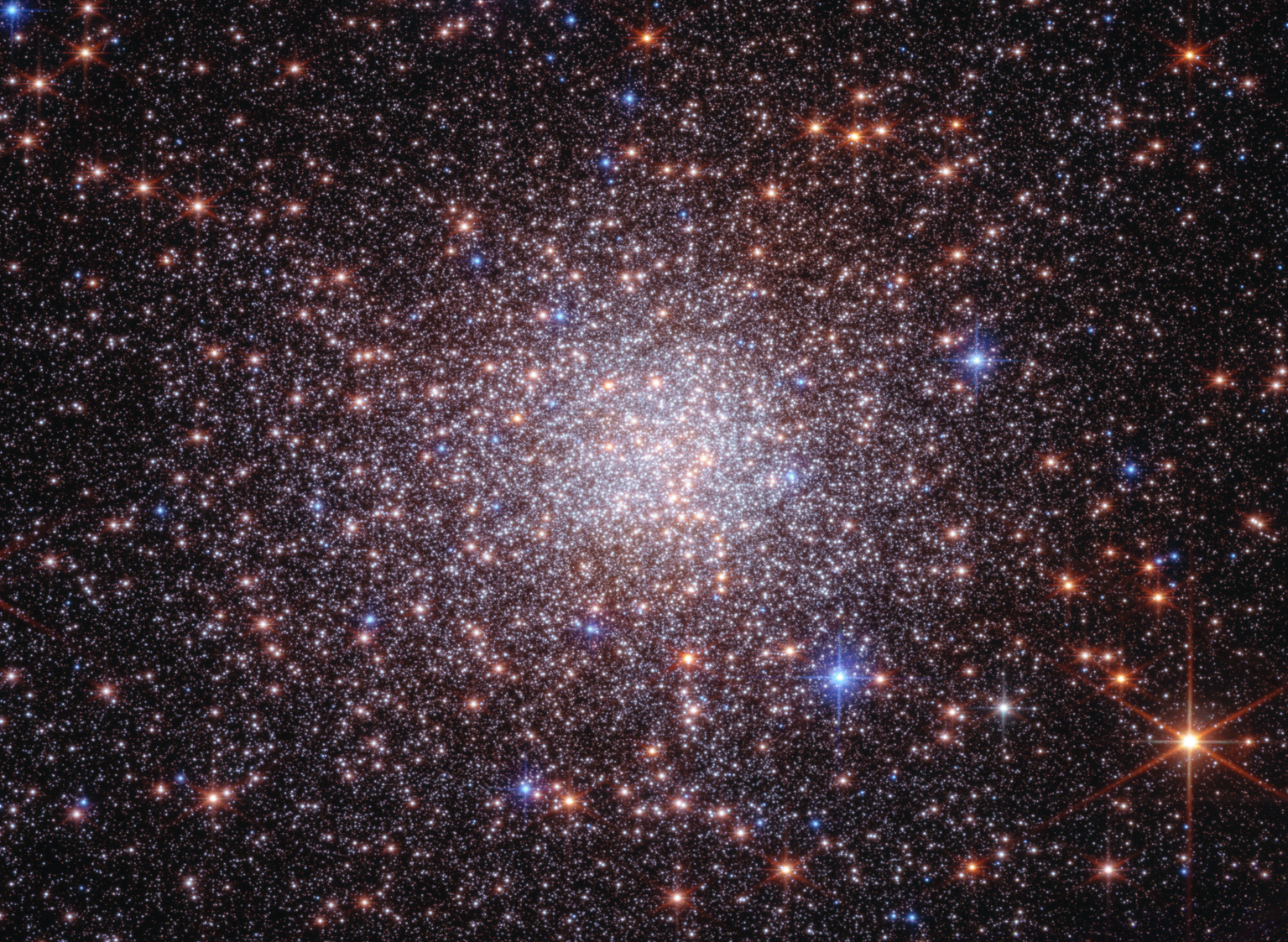
New observations from the James Webb Space Telescope combined with multiple datasets from the Hubble Space Telescope have conclusively shown that Terzan 5 is a self-contained, self-enriching stellar system containing up to four distinct stellar populations. It orbits within the central bulge of our Milky Way galaxy.
Credits: Image: NASA, European Space Agency, Canadian Space Agency, Space Telescope Science Institute, Giorgia Zullo (University of Bologna), Francesco Ferraro (University of Bologna); Image Processing: Alyssa Pagan (STScI)
Researchers using two of humanity’s most advanced observatories — NASA’s James Webb Space Telescope and the Hubble Space Telescope — have definitively demonstrated that Terzan 5 is not a globular star cluster, as it was previously classified. This discovery provides new insight into how galaxies like the Milky Way form and evolve over cosmic time.
A typical globular star cluster contains only a single, ancient stellar population. However, new data not only confirms the presence of two distinct stellar populations in Terzan 5, but also reveals evidence of two additional, more recent episodes of star formation. Although Terzan 5 lies within the densely populated bulge of the Milky Way — the central, spherical region composed mostly of older stars — it was massive enough to preserve its independent identity while lower-mass systems were dispersed and mixed together to form the bulge billions of years ago. Its nature has been compared to a dense lump suspended in otherwise well-mixed cake batter.
“Webb’s new near-infrared observations, cross-referenced with Hubble’s archival data, have provided us with a far clearer reconstruction of the history of Terzan 5,” said Giorgia Zullo, lead researcher and PhD student at the University of Bologna in Italy.
These findings were presented during a press conference on Tuesday at the 248th meeting of the American Astronomical Society in Pasadena and were published in the journal Astronomy & Astrophysics.
Four generations of stars
Terzan 5, first discovered in 1968 by astronomer Azop Terzan, shares several characteristics with globular clusters. However, in 2009 researchers discovered that it contains two distinct stellar populations. Later, in 2016, Hubble observations provided the first age estimates, revealing that one population formed approximately 12 billion years ago — during the early assembly of the Milky Way — while the second formed about 5 billion years ago, shortly before Earth itself began to form. This already indicated a far more complex history than that of a typical globular cluster.
Studying Terzan 5 is challenging due to its position in a highly crowded region of the galaxy and the heavy obscuration caused by interstellar dust. This is where Webb’s infrared capabilities became crucial. Its ability to observe in infrared wavelengths allowed scientists to penetrate the dust and catalog far more stars, including much fainter ones than previously possible. By analyzing stellar color and brightness, astronomers can classify stars into populations of different ages and chemical compositions.
NASA’s Webb telescope measured these key properties for every star in its field of view, including both members of Terzan 5 and unrelated foreground stars. To separate the cluster’s true members, the team relied on the long operational baseline of the Hubble Space Telescope. The 12-year time gap between observations allowed scientists to measure extremely small stellar movements, known as proper motions, distinguishing stars belonging to Terzan 5 from those in the surrounding Milky Way bulge.
By combining Webb and Hubble datasets, the researchers found strong evidence for two additional stellar populations. One formed approximately 3.8 billion years ago, and another only 2.5 billion years ago. They also refined the ages of the previously known populations with unprecedented precision, determining formation times of about 12.5 billion and 4.7 billion years ago.
With only two known generations previously, it was still possible to hypothesize that Terzan 5 had interacted with another object — such as a globular cluster or a massive molecular cloud — which could have introduced fresh gas and triggered a second round of star formation. However, the discovery of four distinct stellar generations rules out these simpler explanations.
Chemical composition measurements of Terzan 5’s stellar populations, obtained using the W. M. Keck Observatory and the Very Large Telescope, also reveal clearly distinct chemical groups. “Along with their ages, the cluster preserves a fossil record of progressive enrichment of heavy elements produced by supernovae,” explained co-author R. Michael Rich, a research astronomer at the University of California, Los Angeles.
Terzan 5 was able to form multiple stellar generations because it retained the material required for star formation over billions of years. Evidence suggests that powerful supernova explosions within the system produced heavy elements that were not expelled into space. Instead, they were retained and recycled into later generations of stars. In lower-mass systems, such explosive events would typically eject gas and elements entirely, preventing further star formation.
‘Bulge fossil fragment’
The results suggest that Terzan 5 is most likely the surviving remnant of a far more massive stellar system that originally formed around 12.5 billion years ago. It is unique because it was never fully merged or mixed into the Milky Way’s bulge during galaxy formation.
“For some reason, this unusual cluster formed independently from the bulge and was never destroyed as the bulge itself formed,” said Francesco R. Ferraro, professor at the University of Bologna and principal investigator of the Webb observations. “Terzan 5 is what we now call a bulge fossil fragment, because it resembles the primordial clumps that contributed to the formation of the bulge.”
To date, only one similar object has been identified: Liller 1, which has also been reclassified from a globular cluster into a bulge fossil fragment due to its multiple stellar generations. Researchers believe that many more such systems may exist. Ferraro’s team plans to study around 40 to 50 additional globular clusters in the bulge region to determine whether they are true single-population clusters or additional fossil fragments with complex histories.
Potential parallels for galaxy formation near and far
This research may significantly improve our understanding of how galactic bulges form over hundreds of millions of years. “Based on observations and detailed simulations, we believe that early galaxies contained large gas-rich disks that fragmented into massive clumps, which formed stars,” explained Barbara Lanzoni, co-author and associate professor at the University of Bologna. “These clumps gradually migrated toward the galactic center and merged, forming the bulges we observe today.”
The James Webb Space Telescope has already identified several examples of such clumpy, actively star-forming galaxies in the early universe, when it was only a few hundred million years old — including structures such as those seen in the Firefly Sparkle galaxy. According to Lanzoni, Terzan 5 may represent direct fossil evidence supporting this formation pathway for galactic bulges across the universe.
The NASA James Webb Space Telescope is the world’s leading space science observatory. It investigates the origins of the universe, studies distant worlds, and explores the fundamental structures of cosmic evolution. Webb is an international mission led by NASA in partnership with ESA and CSA.
The Hubble Space Telescope has been operating for more than three decades and continues to provide groundbreaking scientific discoveries that reshape our understanding of the universe. It is a joint mission between NASA and ESA, with mission operations managed by NASA’s Goddard Space Flight Center in Maryland. Lockheed Martin Space supports operations, while the Space Telescope Science Institute in Baltimore conducts science operations for NASA.
To learn more about Webb, visit:
NASA Webb
To learn more about Hubble, visit:
NASA Hubble