SpaceX Launches Three Massive BlueBird Direct-to-Cell Satellites from Florida
- Space Exploration
- June 17, 2026
- 14
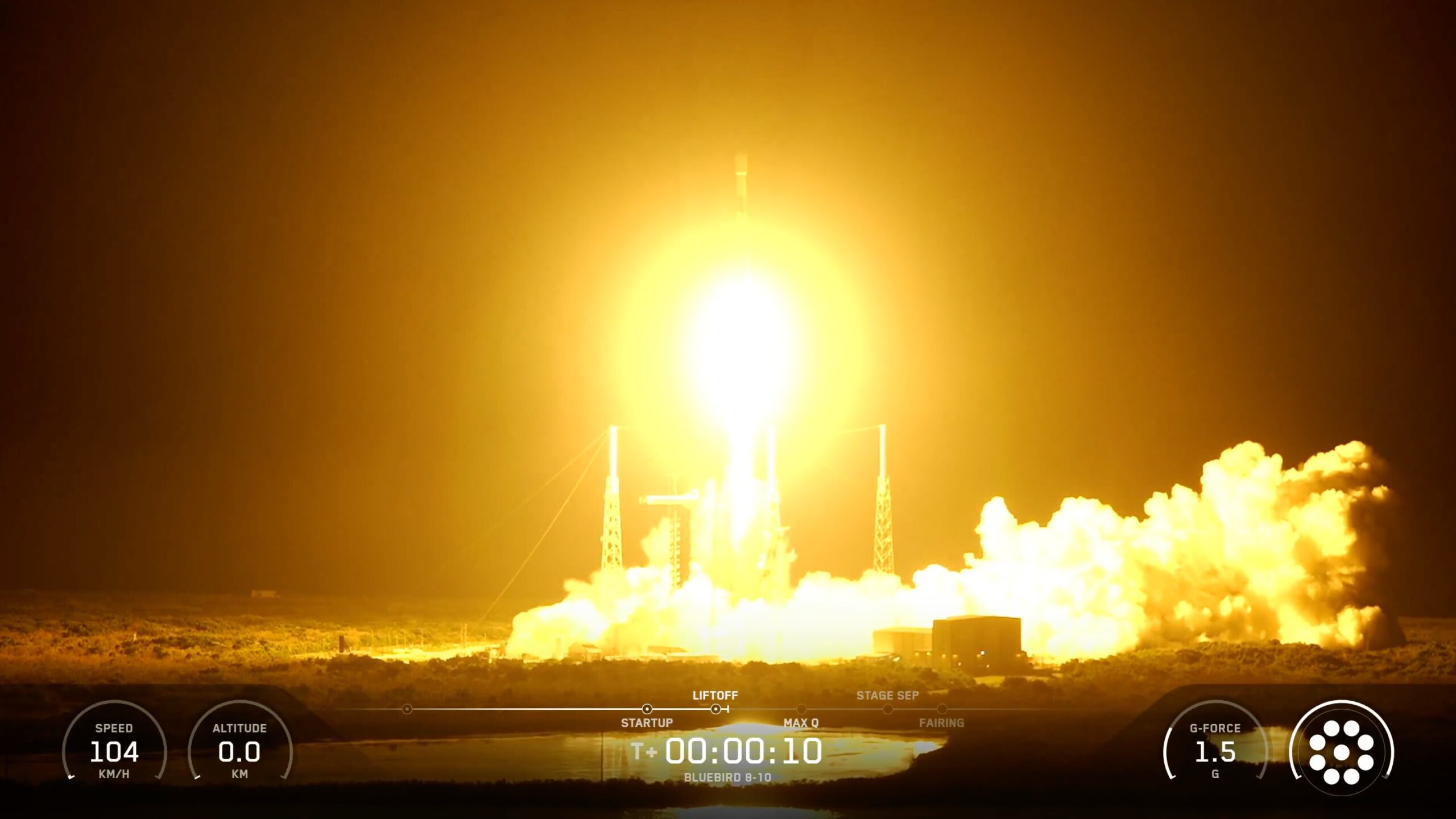
SpaceX successfully launched three large direct-to-cell communications satellites for AST SpaceMobile from Florida’s Space Coast early on June 17.
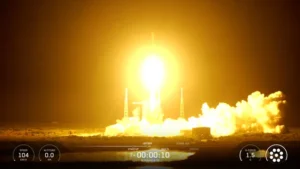
The mission, known as BlueBird 8-10, lifted off aboard a Falcon 9 rocket from Cape Canaveral Space Force Station at 2:39 a.m. EDT (0639 GMT).
Successful launch and booster recovery
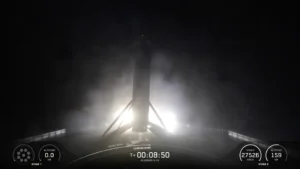
Shortly after launch, the Falcon 9’s first-stage booster completed its mission and returned safely to Earth. Approximately 8.5 minutes after liftoff, it landed on SpaceX’s autonomous drone ship, A Shortfall of Gravitas, stationed in the Atlantic Ocean.
According to SpaceX, this marked the 29th launch and landing for the reusable booster, highlighting the company’s continued progress in rocket reusability.
If the remainder of the mission proceeds as planned, the rocket’s upper stage will deploy the three BlueBird satellites over a period of approximately 10.5 minutes, beginning about 54.5 minutes after launch.
Expanding a space-based cellular network
AST SpaceMobile is developing a constellation of satellites in low Earth orbit designed to provide broadband connectivity directly to standard mobile phones without requiring specialized hardware.
Prior to this mission, the company had launched seven satellites. The most recent launch occurred on April 19, when BlueBird 7 flew aboard the third flight of Blue Origin’s New Glenn rocket.
However, that mission experienced a launch anomaly that placed BlueBird 7 into an incorrect orbit, resulting in the loss of the spacecraft.
BlueBird 7 had been the second of AST SpaceMobile’s next-generation satellites, following BlueBird 6, which successfully reached low Earth orbit aboard an LVM3 rocket launched from India in December 2025.
Record-breaking satellite size
The company’s next-generation BlueBird satellites are among the largest commercial communications spacecraft ever deployed.
Once fully unfolded, each satellite’s communications array covers nearly 2,400 square feet (223 square meters), making it larger than any other commercial communications antenna system currently operating in space.
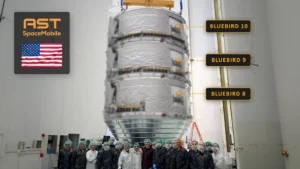
For comparison, the original BlueBird satellites featured arrays covering approximately 693 square feet (64.4 square meters).
The launch of BlueBird 8, BlueBird 9, and BlueBird 10 significantly expands the next-generation portion of the constellation, increasing the number of these advanced satellites in low Earth orbit from one to four.
Building global direct-to-phone connectivity
“Our upcoming launch marks another important milestone as we continue advancing the deployment of our space-based cellular broadband network,” said Scott Wisniewski, president of AST SpaceMobile, in a statement released on June 9.
“Each BlueBird satellite launched expands our ability to support seamless space-based broadband mobile connectivity directly to everyday smartphones,” he added.
As additional satellites join the constellation, AST SpaceMobile aims to create a global network capable of providing cellular coverage in remote and underserved regions where traditional ground-based infrastructure is limited or unavailable.