NASA’s Webb Finds Possible ‘Direct Collapse’ Black Hole
- Space Exploration
- May 10, 2026
- 15
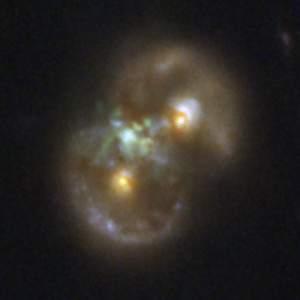
As data from NASA’s James Webb Space Telescope becomes publicly available, researchers continue searching its archives for unusual cosmic objects. While analyzing images from the COSMOS-Web survey, Pieter van Dokkum of Yale University and Gabriel Brammer of the University of Copenhagen identified a striking object they nicknamed the Infinity Galaxy.
The system shows an unusual structure consisting of two extremely compact, red galactic nuclei, each surrounded by a ring-like feature, creating a shape reminiscent of the infinity symbol (∞). Researchers believe this structure likely formed as a result of a head-on collision between two disk galaxies.
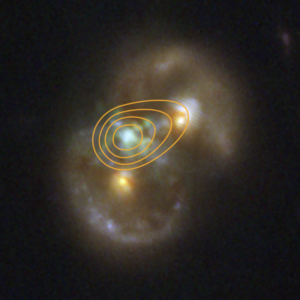
Follow-up observations revealed that the Infinity Galaxy hosts an active supermassive black hole. What makes the system particularly unusual is that this black hole is not located in either of the two galactic nuclei. Instead, it appears to reside in the region between them, embedded within a large reservoir of ionized gas.
The research team proposes that this object may represent a rare example of a direct-collapse black hole — a scenario in which a black hole forms directly from the collapse of a massive gas cloud, rather than growing gradually from stellar remnants.
“Everything is unusual about this galaxy”
Pieter van Dokkum, lead author of the study and principal investigator of follow-up observations, described the object as highly atypical:
“Everything is unusual about this galaxy. Not only does it look very strange, but it also has this supermassive black hole that’s pulling in a lot of material. The biggest surprise was that the black hole is not in either nucleus but in the middle.”
He explained that this placement raises the possibility that astronomers may be witnessing the formation of a supermassive black hole in real time, a phenomenon not previously observed.
Competing theories of black hole formation
Understanding how supermassive black holes form remains one of the major open questions in astrophysics. Two leading theories are typically considered:
Light seed scenario
In this model, black holes form from the collapse of massive stars after supernova explosions, producing relatively small “seed” black holes (up to ~1,000 solar masses). These then grow over time through mergers and gas accretion. However, this process can be too slow to explain the extremely massive black holes observed in the early universe by NASA’s Webb telescope.
Heavy seed (direct collapse) scenario
This alternative proposes that under certain conditions, massive gas clouds can collapse directly into black holes with masses up to a million times that of the Sun. The challenge is that collapsing gas typically forms stars rather than a black hole, making this pathway difficult to realize in practice.
The Infinity Galaxy may provide evidence supporting this second scenario.
A possible formation mechanism
Researchers suggest that the collision of two disk galaxies could have created the necessary conditions for direct collapse. As the galaxies collided, gas clouds were compressed and shocked, potentially forming a dense region capable of collapsing into a black hole.
The system shows several supporting features:
- A large region of ionized hydrogen gas between the two nuclei
- An actively feeding supermassive black hole
- Strong emission detected in X-ray data from Chandra X-ray Observatory
- Radio emissions detected by the Very Large Array
These observations suggest active black hole growth in the central region.
Alternative explanations
The team also considered other possibilities:
- The black hole could be a runaway object, ejected from another galaxy and passing through the system
- It could belong to a faint, undetected third galaxy aligned along the same line of sight
However, both alternatives face difficulties. A background galaxy would likely be detectable, and runaway black holes would not necessarily share the same velocity as the surrounding gas.
The key test: measuring motion
To test their hypothesis, researchers compared the velocity of the black hole with the velocity of the surrounding gas. If the black hole formed in place, both should move together.
Follow-up observations using Webb showed that:
- The black hole lies at the center of the gas velocity distribution
- Its motion closely matches the surrounding ionized gas (within ~50 km/s)
This strengthens the case that the black hole formed in situ.
A system with three active black holes
An unexpected result from the follow-up data is that both galactic nuclei also contain active supermassive black holes. This means the system hosts three active black holes in total:
- One in each of the two galactic nuclei
- One in the central region between them
Cautious conclusion
Researchers emphasize that the results are not yet definitive. However, the evidence increasingly supports the idea that this may be a newborn supermassive black hole formed through direct gas collapse, while several alternative explanations are becoming less likely.
Further analysis of Webb data will continue to refine the interpretation of this rare and complex system.