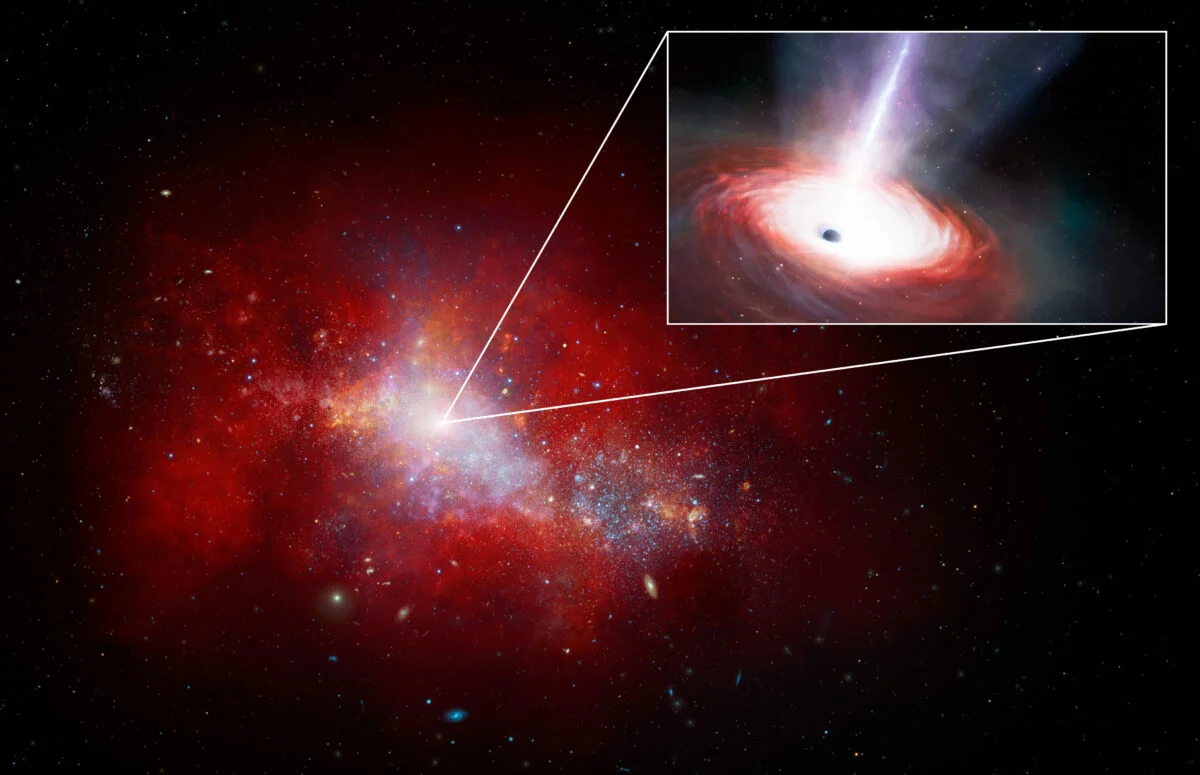
Astronomers have uncovered a groundbreaking clue in understanding the rapid growth of supermassive black holes, thanks to the discovery of LID-568. This black hole, observed in a galaxy just 1.5 billion years after the Big Bang, is defying the well-established Eddington limit by consuming matter at rates 40 times higher than previously thought possible.
A Hungry Black Hole
The study, conducted using the James Webb Space Telescope (JWST), focused on galaxies identified by the Chandra X-ray Observatory. LID-568 stood out for its intense X-ray emissions, prompting astronomers to investigate further. By employing JWST’s Near InfraRed Spectrograph (NIRSpec) in integral field spectrography mode, researchers captured not only the black hole’s light but also data on the surrounding gas flows. This method revealed that LID-568 is undergoing an extreme episode of super-Eddington accretion, a phenomenon where material falls into the black hole much faster than the theoretical maximum.
Breaking the Rules
The Eddington limit describes the balance between gravitational forces pulling matter into a black hole and the outward pressure of radiation. For decades, this limit has defined the maximum growth rate for black holes. However, the existence of massive black holes early in the universe has posed a long-standing mystery, as their rapid growth seemed impossible within the constraints of this limit.
LID-568 challenges these assumptions by showing that black holes can temporarily bypass the Eddington limit, growing rapidly in short bursts. This discovery provides the first direct evidence of such super-Eddington accretion, suggesting that early black holes may experience intense feeding episodes, enabling them to reach enormous sizes within a relatively short cosmic timeframe.
Implications for Black Hole Formation
The findings have profound implications for our understanding of supermassive black hole formation. Rapid, unstable feeding episodes could explain how these colossal objects reached their current masses during the universe’s infancy. This new perspective reshapes the narrative of black hole evolution and highlights the dynamic processes at play in the early cosmos.
As LID-568 demonstrates, black holes may occasionally break the “rules,” offering tantalizing insights into the mechanics of their growth and the extreme conditions of the early universe. This discovery opens new doors for further exploration of supermassive black holes and the fundamental physics governing their behavior.